NATIONALLY ACCEPTED
Accepted in all 50 states instantly
ILCOR & ECC STANDARDS
Our Courses are as per guidelines
ONLINE ACCESS 24/7
All of our services are 100% online


| Types of AV Block | |
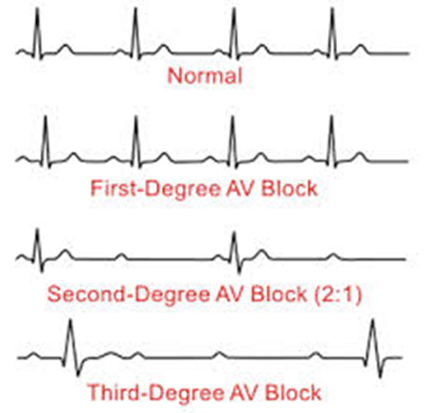
| First Degree AV Block | May be present in healthy children May be due to cardiac infection, MI, electrolyte imbalances, increased vagal tone, cardiac surgery, acute rheumatic fever, drugs Calcium channel blockers and digoxin may cause Characterized by prolonged PR interval Does not cause symptoms |
| Second Degree AV Block – Mobitz Type I (Wenckebach) | May occur in heathy children or as a result of vagal stimulation, MI, drugs (calcium channel blockers, digoxin, and beta blockers) Progressive prolongation of PR interval until P wave disappears. |
| Second Degree AV Block – Mobitz Type II | Generally caused by conduction system abnormalities May be caused by cardiac surgery or MI Not usually caused by drugs Some P waves are blocked PR interval constant Often every other P wave is blocked Symptoms include: lightheadedness, palpitations, and fainting |
| Third Degree AV Block | Caused by conduction system disease or injury, cardiac surgery, MI, congenital malformations, increased parasympathetic tone, drugs, severe hypoxia, and severe acidosis P waves and QRS complexes not related Atrial impulses do not reach ventricles Tiredness, lightheadedness and fainting may occur |
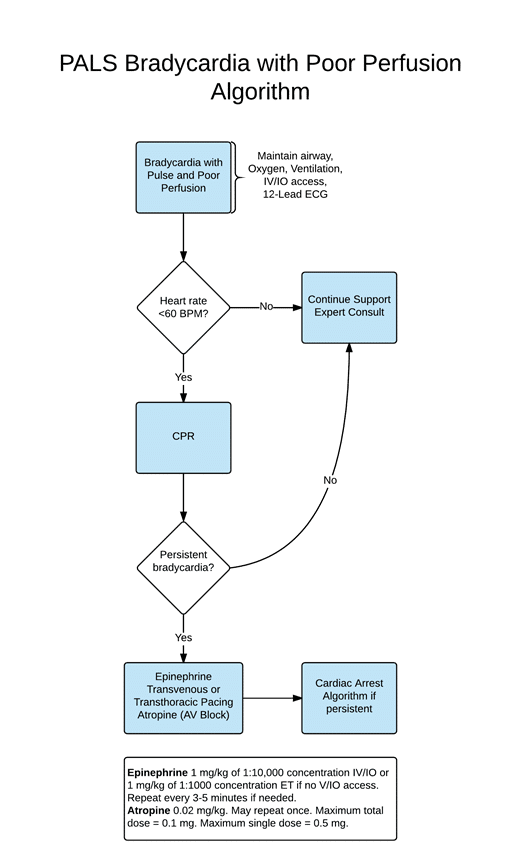
Bradycardia with poor perfusion is treated according to the algorithm.
Identify and treat reversible causes of bradycardia.